Hello again! in this new blog I will explain you more in depth the 4 cases of factorization.

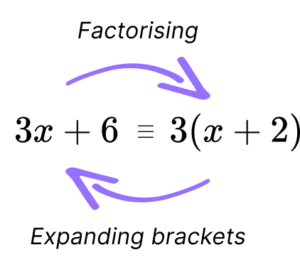
1. common factor.
Factoring by common factors is a technique used to simplify algebraic expressions. It involves identifying common factors in the terms of an expression and factoring them out. The goal of factoring by common factors is to make an expression simpler and easier to work with.
To factor by common factors, we first identify the common factor in each term of an expression. The common factor is usually the highest common factor (HCF) of the coefficients and variables in the terms. For example, in the expression 6x^2 + 12x, the common factor is 6x. We can factor out this common factor by dividing each term by 6x, which gives us 6x(x + 2).
Factoring by common factors can be used to simplify expressions and solve equations. It is especially useful in situations where we need to find a common factor in a set of terms. For example, when adding or subtracting fractions with different denominators, we can factor the denominators and find the lowest common multiple (LCM) to simplify the expression.
Factoring by common factors can also be used to solve quadratic equations. By factoring out the common factor in the terms of a quadratic equation, we can simplify the equation and make it easier to solve. For example, in the quadratic equation 2x^2 + 4x = 0, we can factor out 2x to get 2x(x + 2) = 0. This gives us two solutions: x = 0 and x = -2.
Overall, factoring by common factors is a useful technique for simplifying algebraic expressions and solving equations. It can help us identify common factors in expressions, which can lead to simpler and more efficient solutions.
2. trinomials:
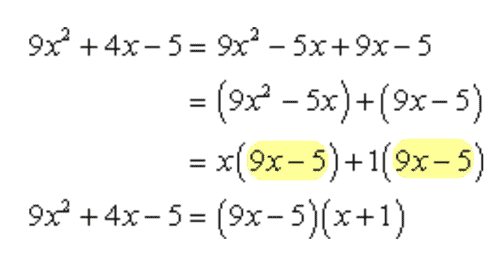
Factoring by the trinomial method is a technique used to factorize quadratic expressions of the form ax^2 + bx + c. It involves finding two numbers that multiply to give the constant term (c) and add up to give the coefficient of the x-term (b). These two numbers are then used to rewrite the quadratic expression as a product of two binomials.
To factorize a quadratic expression using the trinomial method, we first write the expression in the form ax^2 + bx + c. We then identify the values of a, b, and c. Next, we find two numbers, let's call them m and n, that multiply to give ac and add up to give b. For example, if we have the expression 2x^2 + 7x + 3, we can find two numbers that multiply to give 6 and add up to 7, which are 3 and 2. We then rewrite the expression as (2x + 3)(x + 1).
Factoring by the trinomial method can be used to solve quadratic equations, simplify expressions, and solve real-world problems. It is particularly useful when the quadratic expression cannot be factored using other methods such as factoring by common factors or factoring by grouping.
The trinomial method is an important tool in algebra and is used in many fields, including engineering, physics, and computer science. By factoring quadratic expressions, we can simplify complex equations and make them easier to work with. This can help us solve problems and make predictions in a wide range of applications.
3. difference of cubes:
Factoring by the difference of cubes method is a technique used to factorize expressions of the form a^3 - b^3. It involves recognizing that the expression is the difference of two cubes, and then applying a specific formula to factorize it into two binomials.
The formula for factoring the difference of cubes is:
a^3 - b^3 = (a - b)(a^2 + ab + b^2)
To factorize an expression using the difference of cubes method, we first identify whether the expression is in the form of a^3 - b^3. If it is, we then identify the values of a and b. We can then apply the formula to factorize the expression into two binomials. For example, if we have the expression 8x^3 - 27y^3, we can factor it into (2x - 3y)(4x^2 + 6xy + 9y^2).
Factoring by the difference of cubes method can be used to simplify expressions, solve equations, and solve real-world problems. It is particularly useful in situations where we need to factorize an expression that is the difference of two cubes.
The difference of cubes method is an important tool in algebra and is used in many fields, including physics, engineering, and computer science. By factoring expressions using this method, we can simplify complex equations and make them easier to work with. This can help us solve problems and make predictions in a wide range of applications.

4. difference of squares:
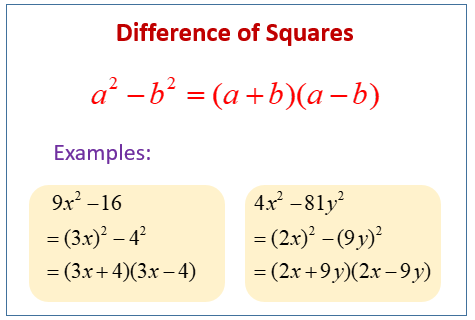
Factoring by the difference of squares method is a technique used to factorize expressions of the form a^2 - b^2. It involves recognizing that the expression is the difference of two squares, and then applying a specific formula to factorize it into two binomials.
The formula for factoring the difference of squares is:
a^2 - b^2 = (a + b)(a - b)
To factorize an expression using the difference of squares method, we first identify whether the expression is in the form of a^2 - b^2. If it is, we then identify the values of a and b. We can then apply the formula to factorize the expression into two binomials. For example, if we have the expression 9x^2 - 4y^2, we can factor it into (3x + 2y)(3x - 2y).
Factoring by the difference of squares method can be used to simplify expressions, solve equations, and solve real-world problems. It is particularly useful in situations where we need to factorize an expression that is the difference of two squares.
The difference of squares method is an important tool in algebra and is used in many fields, including physics, engineering, and computer science. By factoring expressions using this method, we can simplify complex equations and make them easier to work with. This can help us solve problems and make predictions in a wide range of applications.
sources:
https://co.pinterest.com/search/pins/?q=cursed%20cats&rs=typed
https://www.onlinemathlearning.com/image-files/difference-of-squares.png
https://www.chilimath.com/wp-content/uploads/2019/03/sd2c-case2.jpg
https://www.chilimath.com/wp-content/uploads/2021/02/example8a.png
https://thirdspacelearning.com/wp-content/uploads/2022/05/Factorising-backlog-image-1-300x267.png
Comentarios
Publicar un comentario